
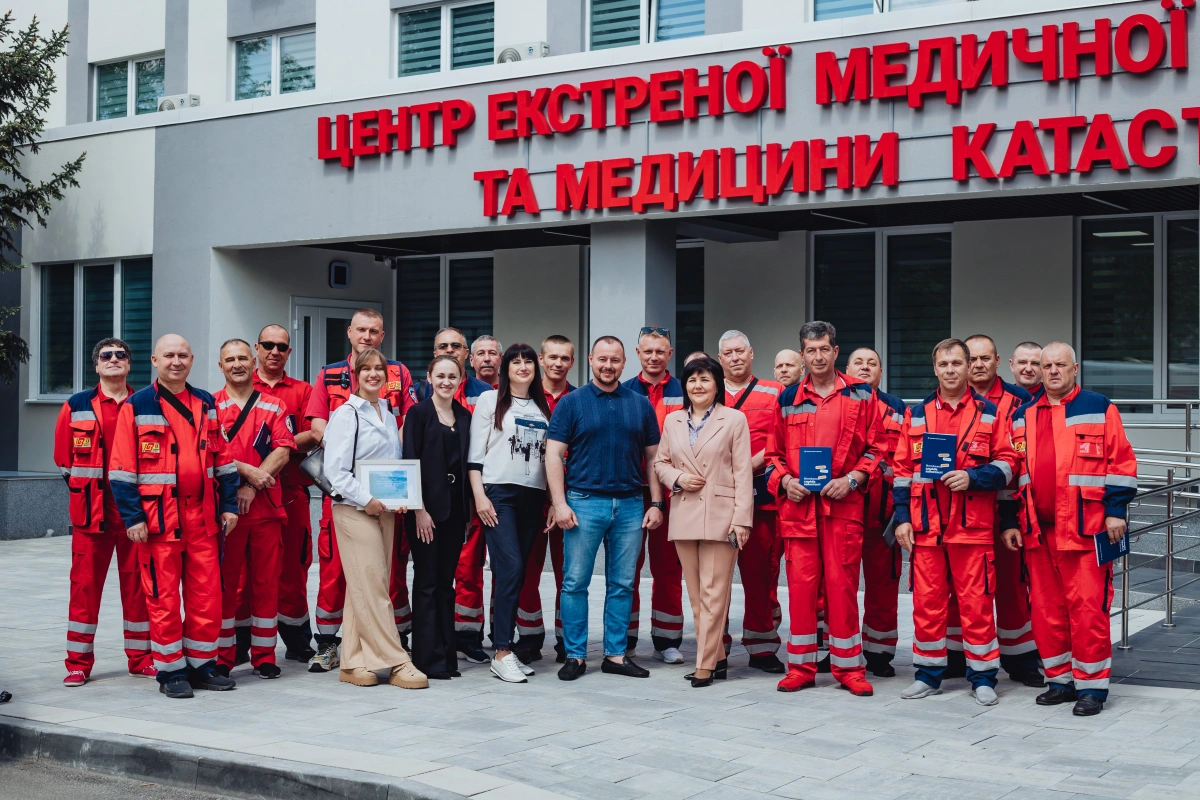
The municipal non-profit enterprise "Territorial Medical Association "Regional Center for Emergency Medical Care and Disaster Medicine" of the Zaporizhia Regional Council" has been ensuring the continuous functioning of the emergency medical care system in the frontline region for many years, especially in conditions of full-scale war.
Despite constant shelling, risks to the lives of personnel, damage to infrastructure, shortage of resources and extraordinary workload, emergency medical teams continue to respond to calls every day, rescue victims, evacuate civilians, provide emergency care to the wounded and ensure stable operation of the regional healthcare system.
This phenomenon is a manifestation of the Greatness of Ukraine, since we are not talking about an individual heroic act, but about the many years of collective resilience of the medical community, which, even in the most difficult conditions, did not stop fulfilling its professional and human duty. Emergency medical workers have become a symbol of endurance, professionalism, self-sacrifice, and service to people.
The activities of the enterprise are directly related to the preservation of life and health of the population. Emergency medical teams are the first to arrive at the victims of hostilities, emergencies, road accidents and urgent conditions.
The enterprise ensures the round-the-clock functioning of the emergency medical system, medical response to emergencies, patient transportation, stabilization of critical conditions and interaction with other medical institutions.
This work has acquired particular importance in wartime, when the health care system has become one of the key elements of the stability of the state and society.
Emergency medical teams go on calls to frontline cities and villages (Orikhov, Gulyaipole, Stepnohirsk) every day, rescuing civilians directly from under the rubble after air strikes and shelling with MLRS. Since Russian troops regularly use the tactic of repeated strikes on the places of arrival when medics arrive there. Medical personnel work in bulletproof vests and helmets, and ambulances become targets for enemy FPV drones.
In 2022–2023, the Center’s medics were on duty around the clock at the checkpoint in Kamianske and at the refugee registration center in Zaporizhia. As is known, in the first months of the invasion, the village of Kamianske was the only point through which civilians could leave the occupied south. The Russians often detained convoys for days or weeks in the “gray zone” under the scorching sun or rain without water or medicine. The Center’s teams volunteered to be on duty at this extreme checkpoint. Nurses and paramedics provided assistance to people with hypertensive crises, strokes, and heart attacks right in the passenger cars. They pulled pregnant women from buses who were going into premature labor due to stress, and successfully delivered babies in the field. The center's doctors were the first to receive, sort, and provide assistance to thousands of exhausted and wounded people escaping from the blockaded Mariupol and the occupied territories of the Zaporizhia and Kherson regions. Paramedic teams repeatedly went to the "gray zone" to evacuate the seriously wounded, despite the lack of stable "silence regimes".
In Zaporizhia itself, the Center's doctors were also the first to arrive at the sites of the destruction of multi-story buildings, hotels, and industrial facilities. They deployed mobile sorting stations, provided anti-shock assistance on the spot, and promptly evacuated dozens of victims simultaneously
One of the teams of the Hulyaipil substation went on call after a massive shelling with the Grad MLRS. At the scene, they found a man with a traumatic amputation of both legs and critical bleeding. While shells continued to explode around them, paramedics worked on the ground: applying tourniquets, connecting infusion systems to stabilize blood pressure, and administering painkillers. They took the patient out under heavy fire. The man survived only because the medics risked their own lives and did not wait for the alarm to go off.
The team of the KNP "TMO "Regional Center for Emergency Medical Care and Disaster Medicine" ZOR is the embodiment of professional resilience, dedication and readiness to work in conditions of increased danger for the sake of saving people's lives.
Behind the team is the long-standing system of emergency medical care of the Zaporizhia region: doctors, paramedics, emergency medical technicians, dispatchers, drivers, engineering and administrative staff, who together ensure the continuous functioning of the service even in the most difficult conditions of wartime.