
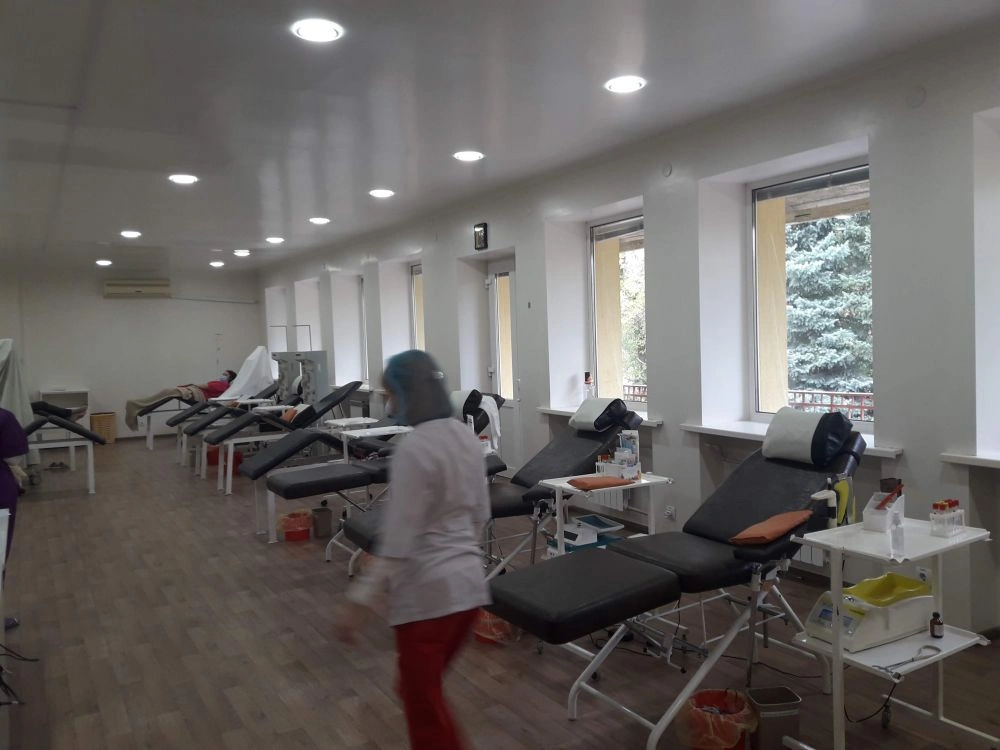
With the beginning of the full-scale invasion, the labor collective of the municipal non-profit enterprise “Blood Transfusion Station of Kramatorsk” found itself at the epicenter of humanitarian and military challenges. Despite the constant threat of shelling, logistical collapse and psychological pressure, the employees do not leave their jobs. Despite the significant aggravation of the security situation, the collective continues uninterrupted activities related to the procurement, processing and delivery of high-quality and safe components of donor blood to where seconds decide everything – to military hospitals and civilian hospitals of the Donetsk region.
The key manifestation of group medical identity was the awareness that the closest qualified help is held by the collective of the Blood Transfusion Station.
Demonstrating strong cohesion and dedication, each employee felt like part of a single rescue mechanism, the main stronghold of life for military and civilians who remained in the risk zone.
The labor team adapted to the extreme conditions of war and turned the Blood Transfusion Station into a fail-safe conveyor belt for saving human lives, realizing that their work is a form of resistance and service to the state!
There are cases when donor blood is almost the only way to save a human life. The staff of the only functioning subject of the blood system in the Donetsk region carries out procurement, forms reserves of donor blood and blood components that help doctors save the lives of military and civilian citizens, perform planned operations, give birth, and perform transplantations. Uninterrupted supply of blood components is the only chance for salvation in case of massive bleeding in wounded soldiers and civilians. The staff of the Blood Transfusion Station directly reduces the mortality rate at the hospital stage.
The sustainability of the national transfusion system in Ukraine is the ability of the blood service to ensure the availability of blood components for civilian and military hospitals, which is especially critical in front-line regions. The KNP “Blood Transfusion Station of Kramatorsk”, as a component of the national blood system, has confirmed its ability to adapt to modern challenges and provide, in particular, the needs of wartime.
The work of the Blood Transfusion Station staff prevents the collapse of the local medical infrastructure, providing other hospitals with a resource for conducting emergency operations under fire.
The existence of a reliable “blood bank” gives the community and the military a sense of security and faith that help will arrive in time. This reduces collective anxiety, strengthens the social connection between the rear and the front, and supports the will to live in the front-line region.
The Blood Transfusion Station team stands guard over a stable network of transfusion services in the Donetsk region and plays a significant role in the front-line medicine system. Thanks to our doctors, routine donation has turned into a reinforced concrete shield for the entire region. They are the symbol of loyalty to the Hippocratic oath, working under cannonade and explosions.
Today, it is the only functioning blood service entity in the Donetsk region. Working under cannonade and explosions, the team ensures uninterrupted procurement, processing and issuance of safe blood components for military hospitals and civilian hospitals in the region.
In a front-line city that is regularly subjected to missile strikes and drone attacks, the station staff continues to procure blood components every day to save lives. As is known, blood components require strict adherence to the temperature regime. Due to regular Russian strikes on the Donetsk region’s energy infrastructure, the station’s staff has learned to instantly switch equipment to stand-alone generators, saving invaluable supplies from damage during long power outages.
Laboratory technicians, doctors, and nurses collect, test, and process blood directly during air raid sirens and the sounds of explosions. The station’s address is no longer widely disclosed in the media for security reasons, but its doors are open to donors every day.
The Kramatorsk station actually maintains the supply of blood components for civilian and military hospitals throughout the Donetsk region. When enemy shells hit residential buildings in Kramatorsk, Kostyantynivka, or Sloviansk, the load on the station increases exponentially — supplies are shipped instantly to save people with traumatic shock and massive bleeding.
Due to the constant evacuation of the population from the frontline zone, the station has lost most of its regular donors. Instead of the usual 40 people per day, now only 7–10 citizens come to donate.
In conditions of acute staff shortage, the remaining specialists work in pairs or threes, combining duties so that blood collection is carried out consistently throughout the week.
Every time after another brutal raid on the city, the station staff publishes appeals about the urgent need for blood. And despite the risk of new attacks, residents of Kramatorsk donate blood of all groups (especially those with a negative Rh factor), confirming that donation in a frontline city is an important line of defense.